 Nederlands
  Français
  Español
  Deutsch
It is not a pleasant question, so most owners think it once and put it away. Usually at night, usually after something reminded them.
If something happens to me tomorrow, who can still reach what the company runs on?
Not the shares, not the will, not the accountant. The everyday things: the bank login, the customer database, the contracts, the domain that renews next month, the cloud console, the payroll portal. Your lawyer cannot help with any of those. Neither can your accountant. They all need access, and access lives in your head.
Your company can still reach everything on the day you cannot
Play it forward honestly. On Monday your team arrives and the work is there, but the keys are not:
- The customer database and the systems your service runs on cannot be reached.
- Contracts, agreements and licences sit behind an account nobody else can open.
- Payments cannot be released, so suppliers and salaries wait.
- The domain cannot be renewed, so mail and the website eventually stop.
- The cloud console cannot be reached, so nothing can be fixed or restored.
- The payroll portal cannot be opened, on exactly the wrong week.
This is not about the value of the company. It is about the handful of accounts that hold everything it runs on, and about the fact that they currently all end at one person.
A Business Continuity plan holds those credentials for the organisation. It is always shared and scoped to a team, so the people you named can reach them when you cannot.
Nobody has to be handed your passwords now
Every familiar solution asks you to give the secret away today, in exchange for cover later.
The envelope with the notary. The sealed note in the safe. The copy with a partner or a family member. Each one is readable the moment somebody opens it, months or years before it was meant to be, and none of them tells you it happened.
Here nothing is handed over in advance. The credentials stay encrypted and split into shares, and your successors can open them only under the conditions you set, when that moment arrives.
One answer from you stops any release, every time
This is the fear that stops people from arranging anything: if I set this up, can it be triggered while I am still here?
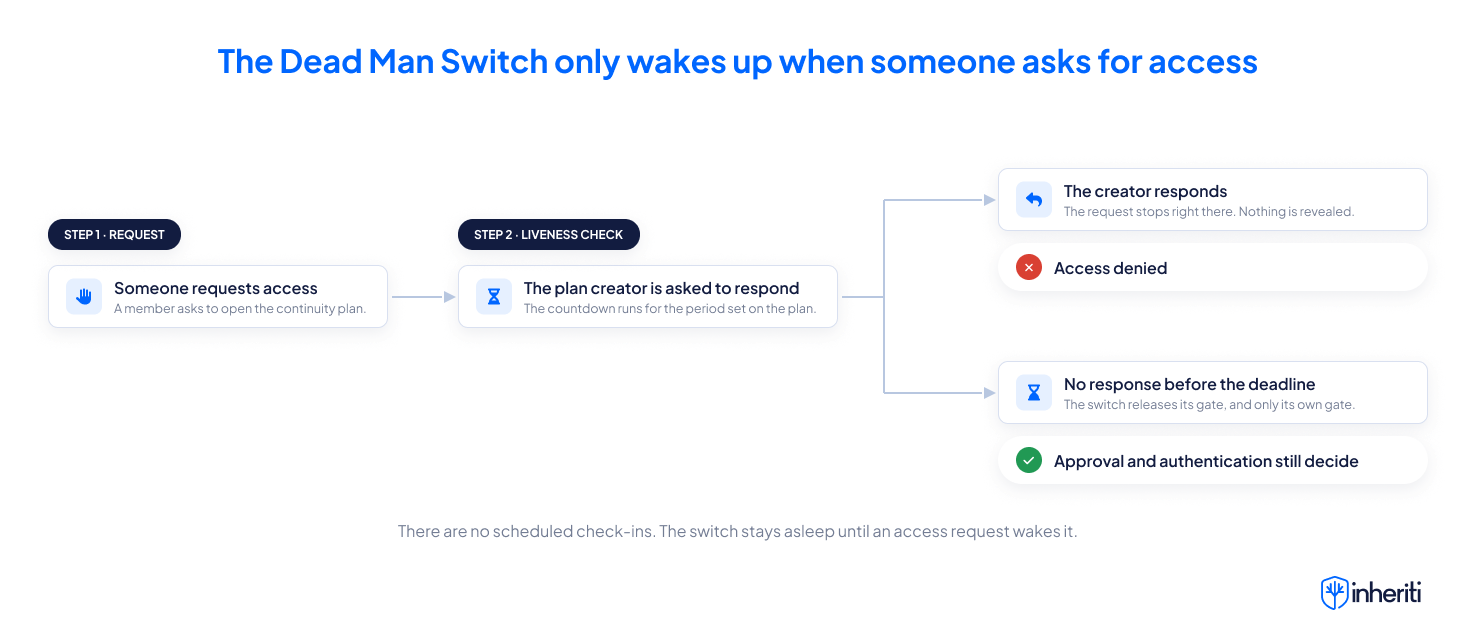
No, and the mechanism is the opposite of what people expect. The Dead Man Switch has no schedule and no heartbeat. It sleeps until someone requests access to the plan. Then you, as the plan’s creator, are asked to respond, and one answer cancels the request. Only silence, for as long as the plan says, lets the switch pass its gate.
And it is an extra gate, never a shortcut. Even after it passes, the plan still requires moderator approval and authentication. The emergency route is not a way around your own rules.
The people who take over are named, not guessed
The other half of the problem is human. Who exactly should be able to continue, and who should not?
That is a list you write while you are around: which teams are on the plan, which members are in those teams, how many moderators must approve a release, and how long the plan waits for your answer. Membership changes take effect immediately, so the arrangement stays as current as your team.
What Inheriti® Business does about it, and why you need it
The reason this subject stays unhandled is that every familiar solution asks you to give the secret away today in exchange for cover later.
Inheriti® Business breaks that trade:
- Nothing is handed over now. The credentials stay encrypted and split into shares, and your successors can open them only when the conditions you set are met.
- The people who take over are named, not guessed, through teams, moderators and an approval threshold you choose.
- The Dead Man Switch has no schedule. It sleeps until someone requests access, and one answer from you cancels the request.
- It is an extra gate, never a shortcut. Approval and authentication still apply after it passes.
- The company keeps reaching what it runs on, because access sits with a team instead of with one person.
That is what turns an uncomfortable thought into an afternoon of work that is actually finished.
Set it up while you are still the one deciding
An afternoon, once.
List what the business cannot reach without you. The customer data, the contracts, the bank, the registrar, the cloud, payroll, the backup system.
Decide who should be able to continue, and how many of them must agree. For most companies two people and one approval is already the difference between a stop and a hiccup.
Put them in a Business Continuity plan in Inheriti® Business, with the response window that fits your life. Then delete the copies you made in the meantime.
Nothing about this makes the subject pleasant. It does mean that if the worst happens, your company does not become a second problem for the people you leave behind. See how Inheriti® Business works.