 Nederlands
  Français
  Español
  Deutsch
Every company has that one person. The one who knows the banking codes, the domain logins, the cloud admin password, the door codes for half the software the business runs on.
Ask yourself one uncomfortable question: what happens the day that person does not show up? Not next year. Tomorrow.
Someone else can step in, without anyone handing over a key
Key person risk gets filed under HR: what if our best salesperson leaves? That version hurts. The version that kills is about access.
One person is the only working path to the accounts your business cannot run without. Nobody planned it that way. It grew:
- The founder opened the bank account, so the founder holds the codes.
- The IT lead registered the domain, so the renewal notice goes to him.
- Someone set up the cloud tenant years ago and never wrote it down.
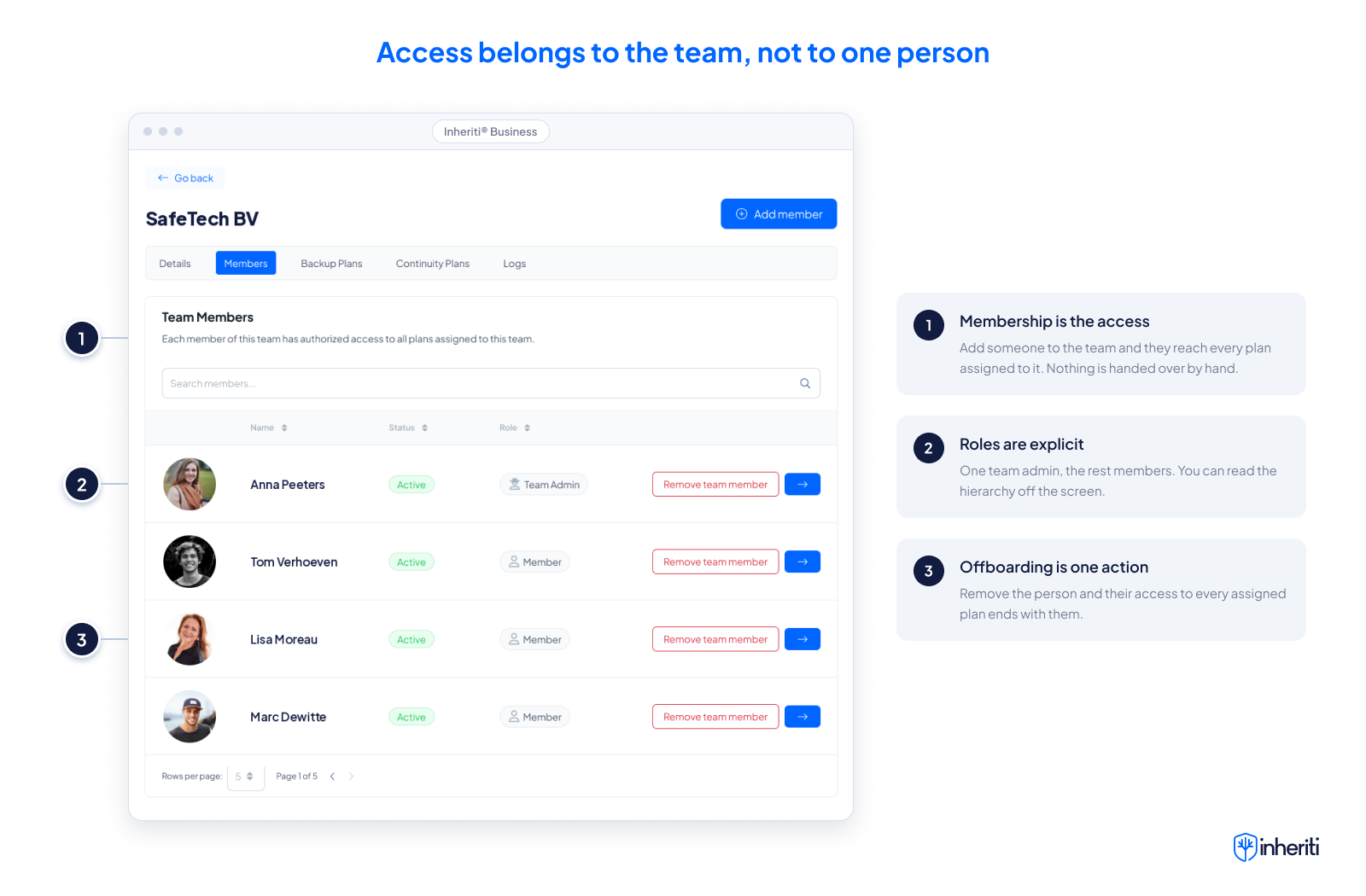
In Inheriti® Business the secret belongs to the organisation, not to a head. A plan is scoped to a team, and every member of that team can reach it through their membership. A second and a third person can always step in, and nobody had to be handed a password to make that true.
The everyday accounts keep working when one person does not
An absence does not announce itself. A burnout, a hospital stay, a sudden resignation, a phone at the bottom of a lake. From that moment the business is locked out of itself:
- Payments cannot be released, so suppliers and salaries wait.
- The domain cannot be renewed, so mail and the website stop.
- The cloud console cannot be reached, so nothing can be fixed or scaled.
- The payroll portal cannot be opened, on the wrong week.
None of that is exotic. It is the ordinary week, running into a door nobody else has a key to.
No readable copy is lying around to be lost or forgotten
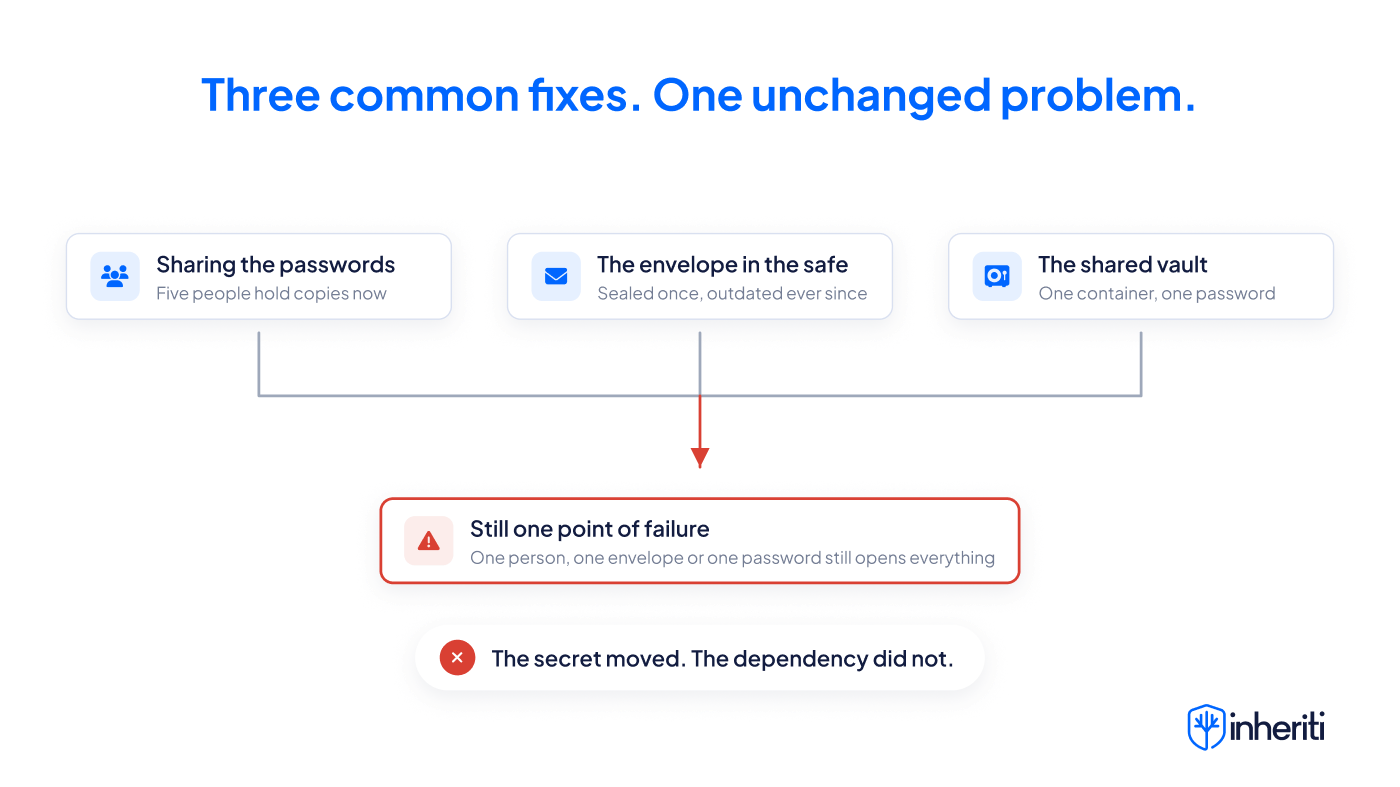
The usual fixes all share one flaw: they hand the secret to somebody else.
The sealed envelope with the notary. The copy with a business partner. The shared vault where a second admin now holds everything. Each of them trades one risk for another, and none of them can be undone once the copy exists.
Inheriti® Business leaves nothing readable behind. The secret is encrypted in the browser, split into shares that are useless alone, and spread across separate storage layers. A colleague with access can open the plan and use the credential, but only from inside the app, only while their team membership says so, and only through the approvals the plan requires.
See who could open what, before you need to know
The honest state of most companies is a guess. Who can reach the bank? Probably two people. Probably.
Access here is a list you can read: which teams are on a plan, which members are in those teams, and which of them are moderators who can approve a request. Every request, approval, denial and reveal lands in the audit trail, so afterwards there is a record instead of a recollection.
Not even we can open it, so there is no single point of failure
The obvious worry: if the secret is not in my safe, is it in yours?
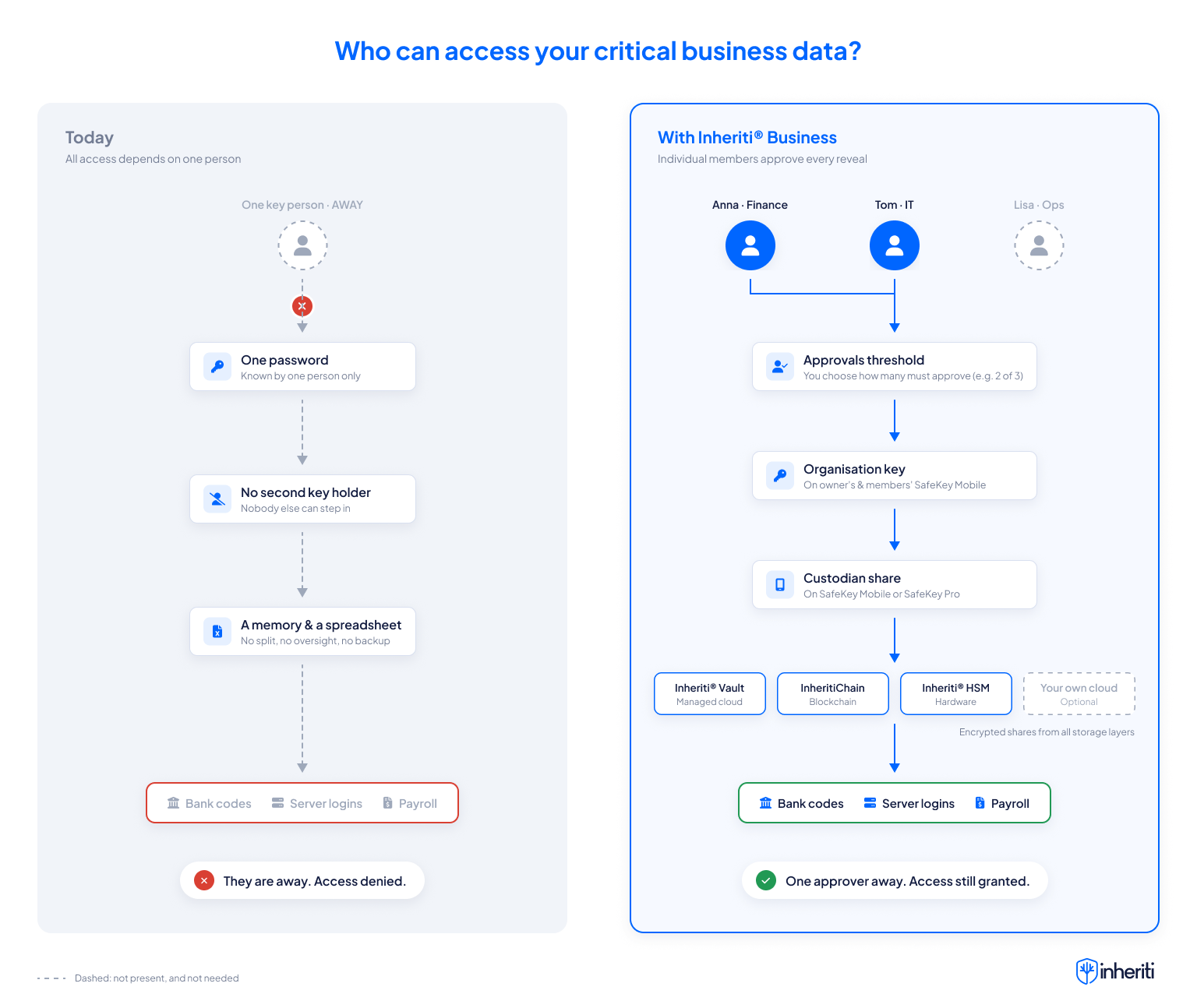
No. The shares are spread so that no single location holds enough to reconstruct anything, and that includes us. The organisation key is derived in the browser and never reaches our servers. Opening a secret needs several things at the same time: an authorised member of the right team at that moment, the organisation key, the distributed shares, and the approvals set on the plan.
Which means the answer to “what if your provider gets hacked” is the same as the answer to “what if my key person is gone”: no single point holds enough to matter.
What Inheriti® Business does about it, and why you need it
Key person risk is not solved by writing something down. It is a design problem: the access lives in one head, and nothing else in the company can reach it.
Inheriti® Business removes that single head:
- Access belongs to a team, not a person, so the right group can open what one absent individual could open.
- Nothing is handed over in advance. The credentials stay encrypted and split into shares, and the people you named can open them only when the conditions you set are met.
- The Dead Man Switch covers the case where you cannot answer at all, and one answer from you cancels any request while you can.
- Every request, approval and reveal is on the record, so nobody has to reconstruct what happened during the worst week of the year.
- No single storage layer holds enough to reconstruct anything, so there is no emergency copy sitting somewhere waiting to be found.
That is the difference between a document that describes access and a plan that is the access.
Start small: your first protection plan
You do not need a project for this. You need an afternoon.
List the accounts that would stop the business today. Bank, domain registrar, cloud, payroll. Usually five to ten.
Ask one question per account: if the person who holds this is unreachable for two weeks, what happens? The uncomfortable ones go first.
Put those into a plan in Inheriti® Business, scoped to the team that needs them, with the approvals that fit. Then delete the readable copies.
From that afternoon on, “who can still log in?” has an answer that does not depend on one person being reachable. See how Inheriti® Business works.