 Nederlands
  Français
  Español
  Deutsch
Somewhere in a drawer or a shared drive sits your continuity planning. Fire, flood, hardware failure, ransomware, a phone tree, a backup office.
Now look for the chapter that answers a simpler question: if the person who holds the passwords is gone, who can still log in? In most plans that chapter does not exist.
Cover the disaster that is most likely to happen
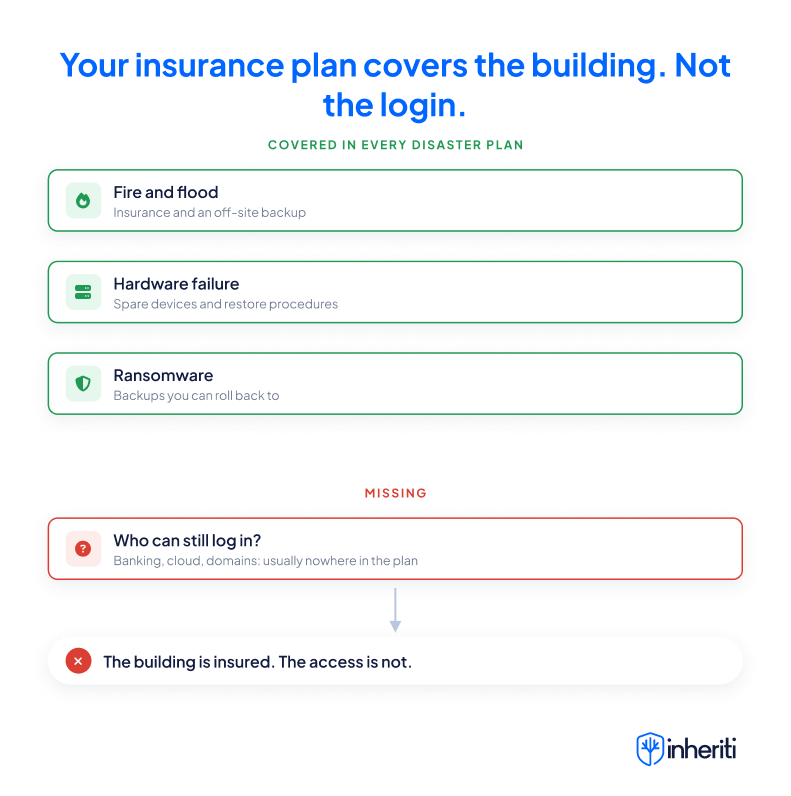
Disaster planning grew up in a physical world, and it still shows. The scenarios are the ones you can photograph:
- Fire and flood, answered with insurance and an off-site backup.
- Hardware failure, answered with spare devices and a restore procedure.
- Ransomware, answered with backups you can roll back to.
All real, all worth having, all about things. Meanwhile the failure that actually stops a company most often is not a thing at all: it is a person who cannot be reached, and access nobody else has.
A plan that covers the building but not the login has a hole in the middle. You can have the backup office, the insurance and the phone tree, and still be unable to pay an invoice on Monday.
Know today which access would stop the business tomorrow
Before any tool, do the inventory. It takes an afternoon and it is uncomfortable in a useful way.
List the accounts the business cannot run without, and next to each one write who can open it today:
- Banking and payment providers.
- Domain registrar and DNS.
- Cloud and server admin accounts.
- Payroll and the insurers.
- The backup system itself, which is often the worst one.
Any line with exactly one name is a single point of failure. Most companies find between five and ten.
A plan that stays current instead of ageing in a drawer
Written plans have a second problem: they rot. The document lists an account that was migrated last year and a person who left in March. Nobody rereads it, because rereading it is nobody’s job.
A Business Continuity plan in Inheriti® Business is not a document about access, it is the access. It is always shared, scoped to a team rather than a person, because its whole purpose is to be reachable by the right group when one individual is not. Membership changes take effect immediately, without re-encrypting anything, so the plan is as current as your team list.
Give nothing away now, and nothing is out of reach later
Every familiar answer to this problem means handing the secret over before you meant to: an envelope with a notary, a copy with a partner, a sealed note in a safe. All three are readable the moment someone opens them, and none of them tells you it happened.
Here nothing is handed over in advance. The credentials stay encrypted and split into shares, and opening them still requires the approvals and the authentication the plan demands. The emergency route is not a way around your rules.
One answer from you stops it, every time
The cruellest problem in continuity planning is the release mechanism. If opening the emergency plan needs sign-off from the boss, what happens when the emergency is the boss?
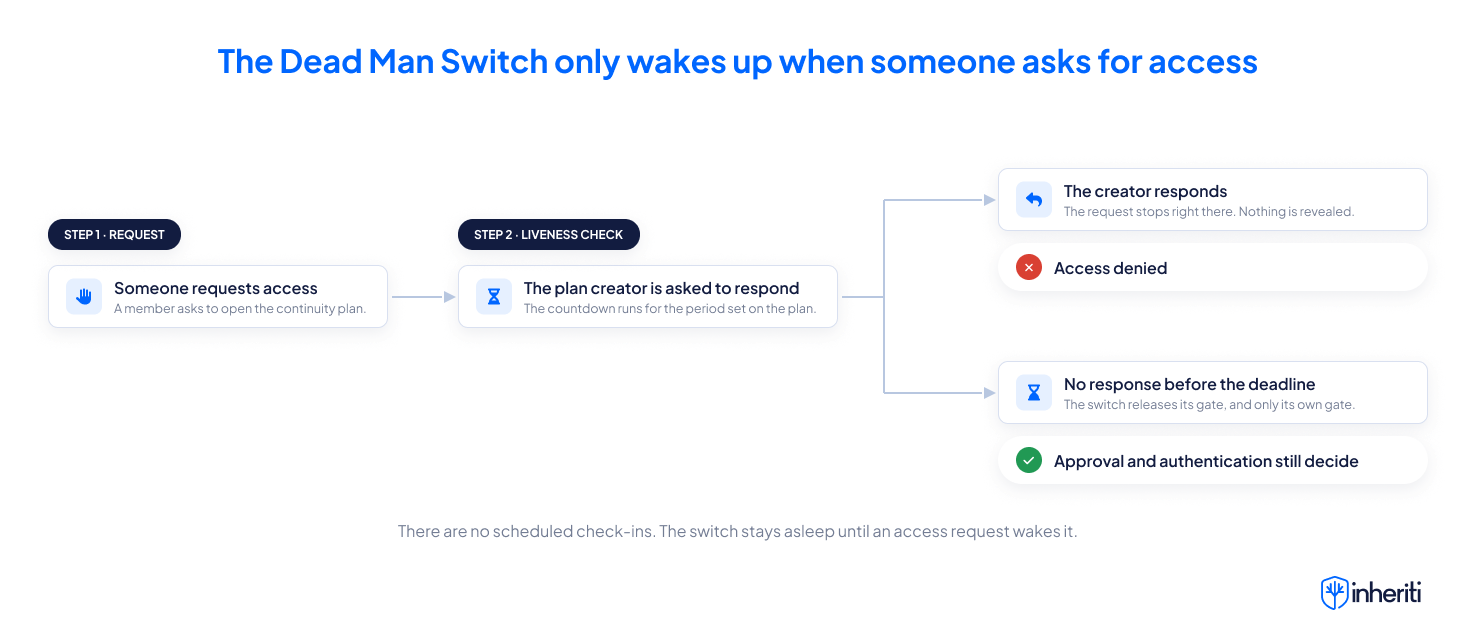
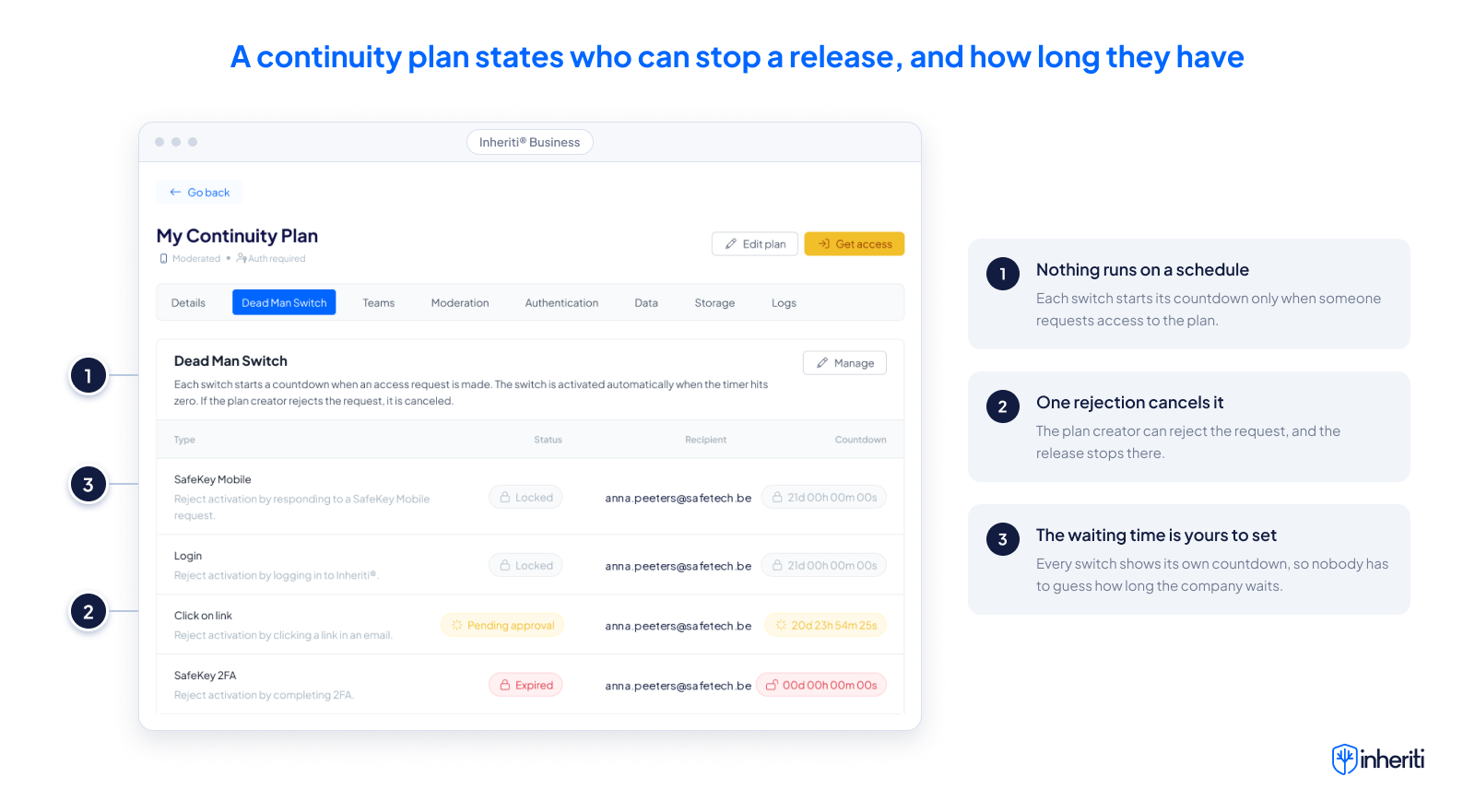
The Dead Man Switch answers that, and it works the other way round from what people expect. It has no schedule and no heartbeat. It sleeps until someone requests access to the plan. Then you, as the plan’s creator, are asked to respond, and one answer cancels the request. Only silence, for as long as the plan says, lets the switch pass its gate.
And it is an extra gate, never a shortcut: after it passes, the plan still asks for moderator approval and authentication.
What Inheriti® Business does about it, and why you need it
A continuity plan that covers the building but not the login has a hole in the middle. Fire, water and hardware have answers. The password does not, because it was never written down on purpose.
Inheriti® Business fills exactly that hole:
- The credentials themselves live in the plan, encrypted in your browser and split into shares, instead of being described by it.
- The plan stays current, because access follows team membership and a change takes effect immediately, with nothing to re-encrypt.
- Nothing is given away in advance. No envelope, no sealed note, no copy with a family member that becomes readable the day someone opens it.
- The Dead Man Switch answers the cruel question: what if the person who must approve the release is the emergency. It sleeps until someone requests access, and your answer cancels it.
- Approvals and authentication still apply, so the emergency route never becomes a way around your own rules.
That is why this belongs next to the insurance policy and not in a folder about it.
From plan to practice in one afternoon
The honest cost of closing the biggest gap in your continuity planning is an afternoon.
Do the inventory above. Take the accounts with a single name next to them. Create your organisation, set up your teams, and put those credentials into a Business Continuity plan with the moderators and the response window that fit your company.
From that moment, “who can still log in?” has an answer that does not depend on any one person being reachable. See how Inheriti® Business works.