 Nederlands
  Français
  Español
  Deutsch
Scroll up in your team’s group chat. Somewhere in there is a password. Maybe it’s just the wifi. Maybe it’s the login for the ad account, the webshop backend, or worse. It was pasted there months ago because someone needed it fast, and it has been sitting there ever since, readable by everyone who was in the chat then and everyone who joined since. That, in one screenshot, is what password sharing risks look like in real life.
Nobody meant any harm. That’s the point. Sharing a password is always the helpful thing to do in the moment. The bill arrives later.
How passwords really get shared
Forget the security policy for a second and look at how it actually happens in a normal week:
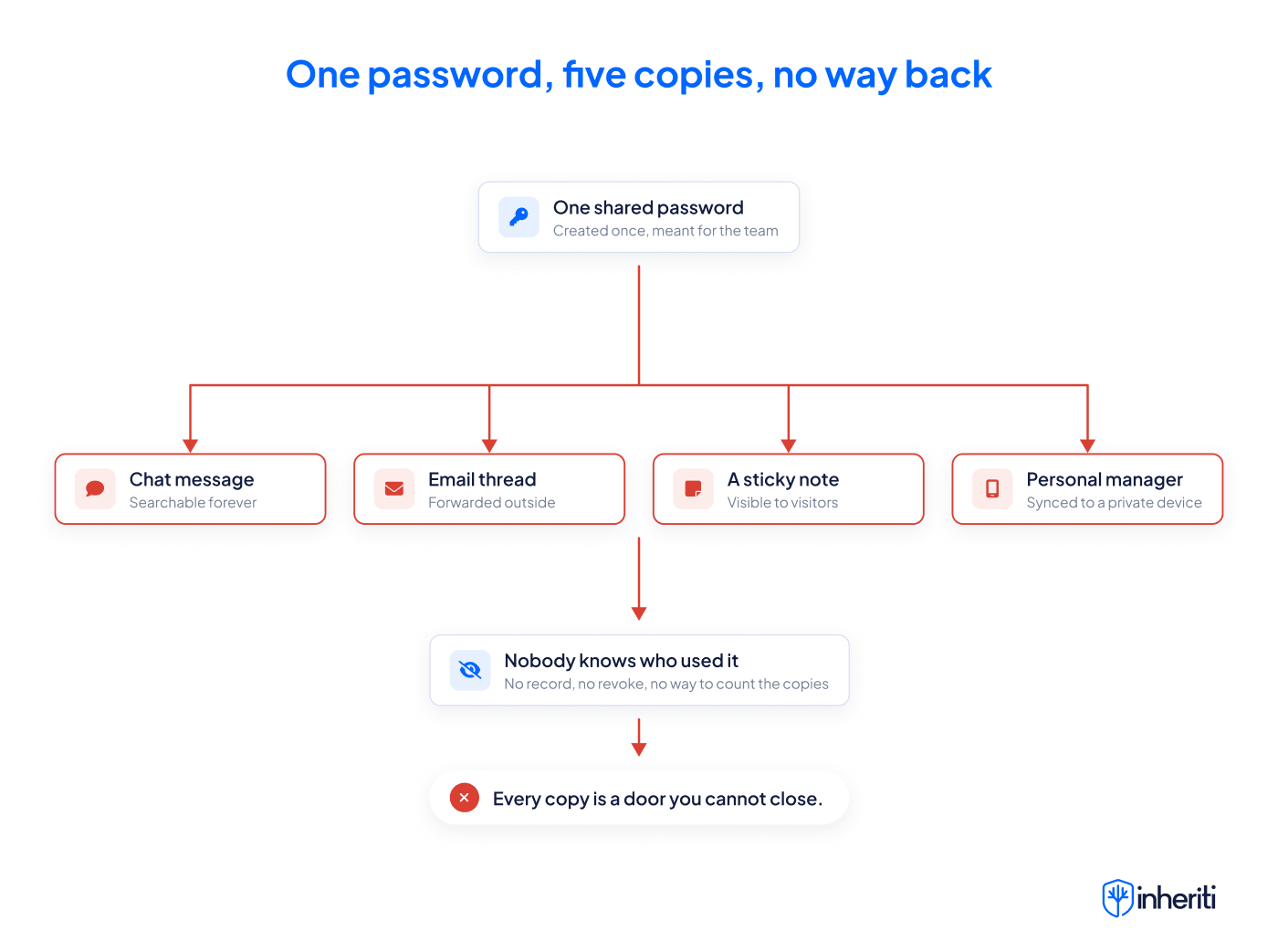
- A colleague is on the phone with a supplier and needs the portal login now. It goes over chat.
- The marketing intern needs the social accounts. Someone forwards an old email that has the credentials in it.
- Finance is out, an invoice is due, so the bookkeeping password gets read out loud across the office.
- A new tool gets one licence “for now”, and five people end up using the same account for a year.
Each of these is a copy. And every copy has three properties nobody thinks about at the time: it doesn’t expire, it can be forwarded, and it leaves no trace. Six months later, the honest answer to “who can access this account?” is: we genuinely don’t know.
What it costs: three bills that always arrive
The password sharing risks that matter aren’t hypothetical. They come due in three predictable ways.
The offboarding gap. Someone leaves the company. IT closes their email and collects the laptop. But every shared password they ever saw still works, and nobody has a list of what they saw. Unless you rotate everything they might have known, on every service, they can still get in. We wrote a whole article on that scenario: Fired Months Ago. They Can Still Get Into Everything Tonight.
No accountability. When five people use one login, the account’s history is a blur. Money moved, a setting changed, data was exported: it was “the account”. If something ever goes wrong, you can’t tell carelessness from malice, and you can’t clear the four innocent people either.
One leak away. Every place a password lives is a place it can leak from. A phone in the wrong hands, a forwarded email, one convincing phishing message to any of the people in that chat. The more copies exist, the more doors lead to the same room, and you only control some of them.
Why a shared vault only moves the problem
The standard answer to all this is a team password manager. And to be fair, it helps: credentials stop living in chat, and daily logins get tidier.
But look at what a shared vault actually is: one container, holding readable copies of everything, opened by one password per person. The copies still exist, now neatly collected in one place. Whoever unlocks the vault sees the secrets in full, can pass them on, and nothing about the vault stops them. And the vault itself becomes the most valuable single target in your company, protected by whatever each person chose as their unlock password.
You started with secrets scattered across chats. You end with secrets stacked in one box. Tidier, yes. But the core problem, uncontrolled copies behind a single key, is still there. It just moved.
Sharing without leaving copies behind
Here is the version of sharing that doesn’t create this mess: never hand out the secret at all. Hand out access to it.
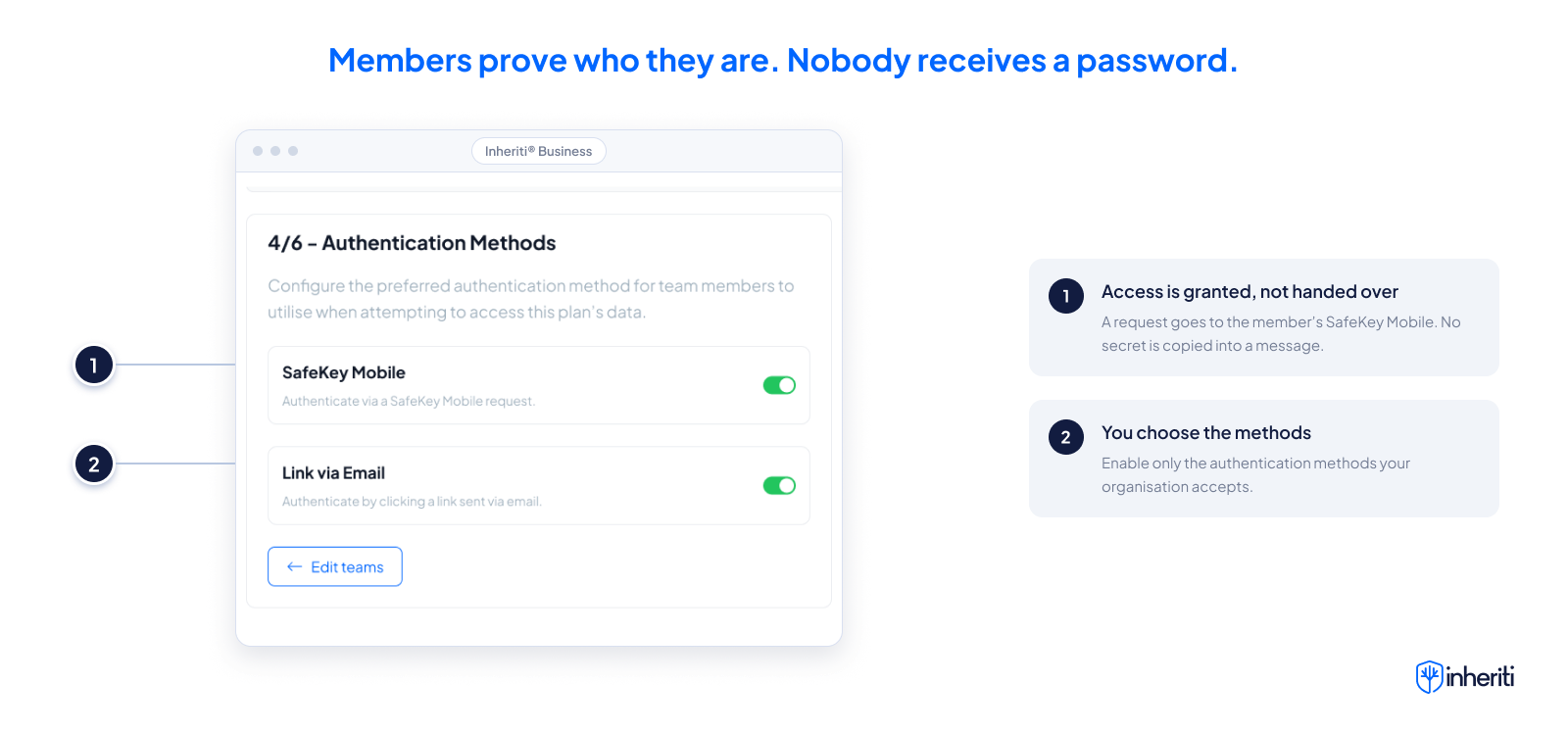
In Inheriti® Business, a credential is never distributed as a copy. It is encrypted in your browser and split into shares that are useless on their own, spread across separate storage layers. What your team members get is not the password in a chat bubble. It is membership of a team that is allowed to request access.
When someone actually needs the secret, they ask for it through the system. The request is checked against your organisation as it stands right now, they confirm on their own device, and if the plan requires it, the moderators you chose approve the request before anything is revealed. That’s controlled access management: the helpful, fast sharing your team wants, without the permanent trail of copies it used to leave behind.
And when someone changes teams or leaves? You update the team, and their access is gone. Immediately, because access is checked at the moment someone opens a secret. For what they already saw, you rotate that one secret, and the old ciphertext is purged.
Every access accounted for
The quiet superpower of sharing this way is that “who used it?” finally has an answer. Every request, approval and reveal in Inheriti® Business is recorded, and you can pull the record per member, per team or per plan, up to a full audit export for the whole organisation.
Compare that to the group chat. The chat tells you a password was posted in March. The audit trail tells you who accessed the credential, when, and who approved it. One of these is an answer you can give an auditor, an insurer, or yourself at 2 a.m. after something odd happened.
What Inheriti® Business does about it, and why you need it
Shared passwords are not a discipline problem. Sharing a secret means copying it, and copies cannot be counted, recalled or watched.
Inheriti® Business breaks the copy:
- Access is a right, not a handover. A member can open something because of their team membership, so nothing has to be taken back later.
- When membership ends, access ends. Share records are marked invalid, and rotating a secret purges the old ciphertext, so a leftover share is inert.
- Nothing readable exists to be forwarded. The secret is encrypted in your browser and split into shares held across multiple storage layers.
- Every reveal is attributed, so “who has this password” becomes a question with an answer instead of a shrug.
- Not even we can open it. The organisation key is derived on your device and never reaches our servers.
The shared password does not need a better hiding place. It needs to stop being a thing that can be passed on at all.
Migrate your worst-shared secrets first
You don’t need to reform your whole company’s habits this quarter. You need to fix the copies that can hurt you most.
Find your three worst-shared secrets. Classics: the banking or payment platform login, the cloud admin account, the credentials in that one pinned chat message. Put them into a protection plan in Inheriti® Business, assign the right team, set the approvals. Then change those passwords one last time, so the old copies floating around your chats and inboxes die for good.
From then on, the answer to “can you send me the password?” becomes “you have access, request it.” Helpful in the moment, and no bill later. See how Inheriti® Business works.